

A Statewide Program Providing Communication Access
Hearing loss makes everyday phone calls harder. Conversations with family members, doctors’ offices, and customer service lines all become more difficult to follow when you can’t catch every word.
It’s a common challenge across Florida. According to the Florida Department of Health, 12.6% of Floridians aged 65 and older live with hearing difficulty. That’s roughly one in eight older adults in the state.
What many Floridians don’t know is that a statewide program provides free amplified phones, cell phone amplifiers, and other communication equipment to qualifying residents. The program is administered by Florida Telecommunications Relay, Inc. (FTRI), a nonprofit that has supported Floridians with hearing and speech challenges since 1991. The equipment is provided at no cost for as long as it is needed.
This guide explains who qualifies, what kind of phones are available, how to choose the right one for your level of hearing loss, and how to apply. By the end, you’ll know whether the program is a fit for you or someone in your family and how to take the next step.
What Is FTRI and Why Does Florida Offer Free Amplified Phones?
Florida Telecommunications Relay, Inc. (FTRI) is a statewide nonprofit that helps Floridians who are deaf, hard of hearing, deafblind, or speech impaired stay connected through specialized communication equipment. Since 1991, FTRI has administered the Specialized Telecommunications Equipment Distribution Program, which provides free amplified phones, cell phone amplifiers, and other communication tools to eligible Florida residents.
The program exists because of a Florida law called the Telecommunications Access System Act, or TASA (Florida Statute Chapter 427, Part II). TASA was established to make sure individuals with communication challenges have access to essential telephone services, regardless of their ability to pay for specialized equipment.
The program is funded by a small monthly surcharge on landline telephone service in Florida. The current surcharge is 8 cents per month. That small contribution from telephone customers across the state pays for the equipment distributed through FTRI, the Florida Relay 711 service, and the support that goes with them.
In other words, this is not charity, and it is not a discount program. It is a service that Floridians have already paid into for decades. If you qualify, the equipment is yours to use at no cost for as long as you need it. There is no application fee, no monthly fee, and no income requirement for landline amplified phones or cell phone amplifiers.
Understanding how the program is funded is often the moment people realize there is no catch. The phones are real, the program is real, and it was built specifically for Floridians like you.
Who Qualifies for a Free Amplified Phone in Florida?

FTRI’s eligibility requirements are straightforward. To qualify for a free amplified phone or cell phone amplifier through the program, you must meet three basic criteria:
- Be a permanent Florida resident. You’ll need to provide proof of residency, such as a Florida driver’s license, state ID, voter registration card, vehicle registration, Medicaid card, or a letter from Social Security showing your Florida address.
- Be at least 3 years old. There is no upper age limit. Many program participants are seniors, but the program serves Floridians of all ages.
- Have a certified hearing loss, deafness, deafblindness, or speech impairment. Your application must be signed by an approved certifier, such as an audiologist, hearing aid specialist, physician, or other qualified professional. If you don’t have a certifier, FTRI staff can help guide you through that step.
There is no income requirement for amplified phones, cell phone amplifiers, or other landline equipment. Whether you are on a fixed retirement income or are fully employed, you qualify based solely on Florida residency and hearing or speech needs.
The program is also open to caregivers and family members applying on behalf of a loved one with permission. If you are helping a parent, spouse, or family member with hearing loss, you can walk them through the process or assist with the application directly.
What Are the Eligibility Requirements for a Free Amplified Phone in Florida?
To qualify for a free amplified phone through FTRI, an applicant must be a permanent Florida resident, at least 3 years old, and have a certified hearing loss, deafness, deafblindness, or speech impairment. The application must be signed by an approved certifier such as an audiologist, hearing aid specialist, or physician. There is no income requirement for amplified phones, cell phone amplifiers, or other landline equipment, and there is no upper age limit. The program is funded by a small monthly surcharge on Florida landline telephone service under the Telecommunications Access System Act. You can apply online for free communication equipment through Florida Telecommunications Relay, Inc.
What Types of Free Amplified Phones Does FTRI Offer?
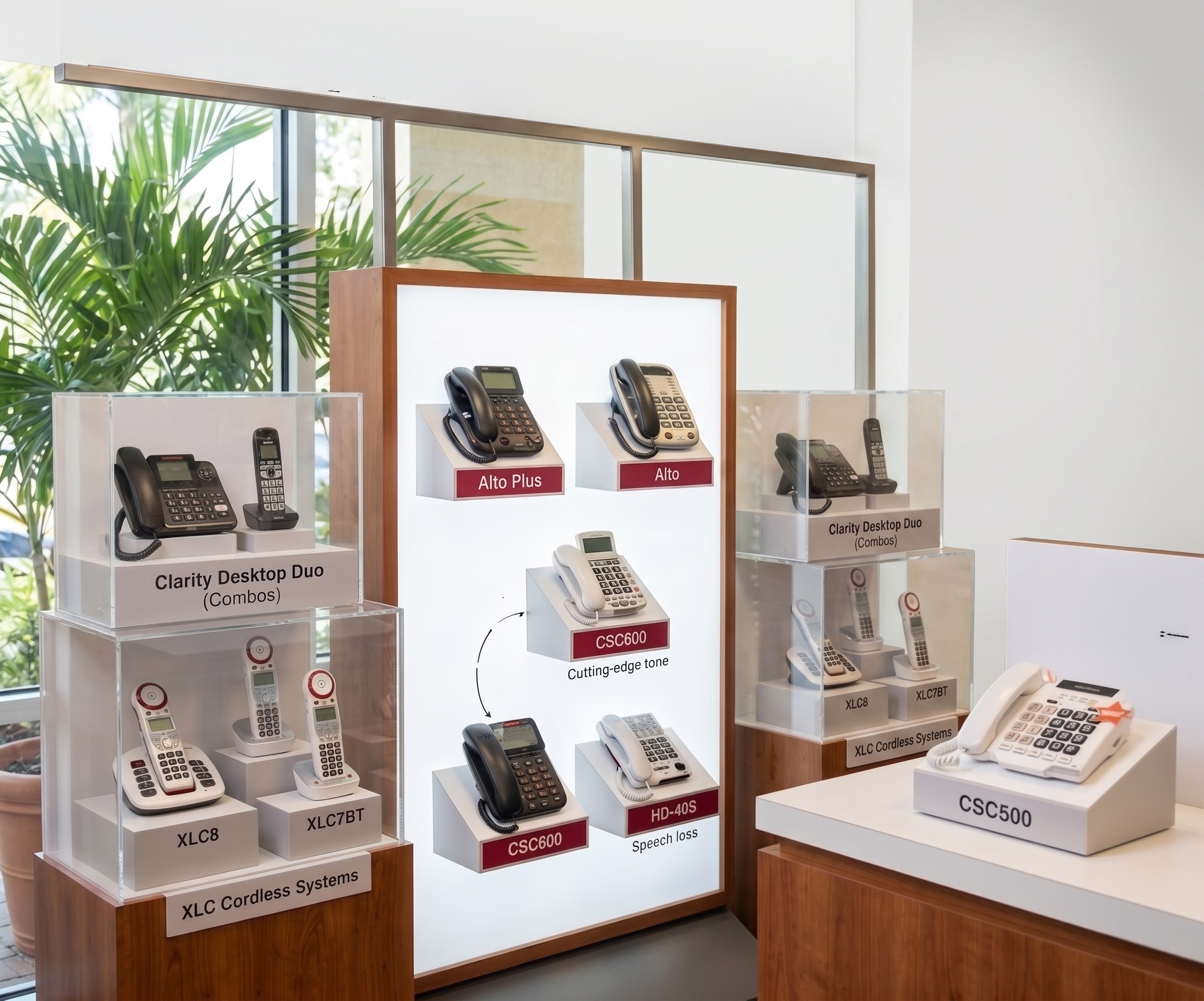
FTRI offers a range of amplified phones and cell phone amplifiers designed for different levels of hearing loss and different ways of communicating. All of the equipment below is provided at no cost to eligible Florida residents.
Corded amplified phones are the most reliable option for clear, consistent sound. They plug into a standard phone line, never need charging, and tend to offer the strongest amplification. Models like the Alto and Alto Plus provide up to 53 dB of amplification, making them a good fit for users with moderate to severe hearing loss who want a dependable home phone.
Cordless amplified phones offer the same amplification benefits with the freedom to move around the house. Some models, like the XLC8 and XLC7BT, also pair with Bluetooth-enabled cell phones, allowing you to take mobile calls through a familiar cordless handset. These are a strong choice for users who want flexibility and the option to combine landline and mobile service in one device.
Cell phone amplifiers are designed for Floridians who rely primarily on a smartphone. Devices like the XLCgo and SA-40 pair with your phone via Bluetooth and amplify the sound of incoming calls, making mobile conversations easier to hear at home, in the car, or on the go. They are portable, rechargeable, and work well in noisier environments.
Speech-amplified phones, such as the HD-40S, are built for individuals who experience both hearing loss and speech difficulties. These phones amplify outgoing speech as well as incoming sound.
FTRI also offers captioned phones, ringers with visual alerts, and specialized devices for unique communication needs. If your situation calls for something different, the application process will help match you with the right equipment.
How to Choose the Right Amplified Phone for Your Level of Hearing Loss
Choosing the right phone comes down to a few simple questions about your hearing, your daily routine, and how you most often make calls. You don’t need to figure this out on your own. FTRI’s application includes a short hearing test that helps match you with the right equipment, but it helps to come in with a general sense of what you need.
How much amplification do you need? Amplification is measured in decibels (dB). For mild to moderate hearing loss, a phone with 30 to 40 dB of amplification is usually enough to make conversations comfortable. For moderate to severe hearing loss, look for models in the 50 dB range. For severe hearing loss, you may want the strongest amplification available, paired with visual support like real-time captions or bright ringer alerts.
Do you want a corded or cordless phone? Corded phones are simpler to use and never need to be charged. They tend to offer the strongest, most consistent sound. Cordless phones give you the freedom to take calls anywhere in the house, and many models include Bluetooth so they can also connect to your cell phone.
Do you mostly use a landline or a cell phone? If most of your calls happen on a smartphone, a cell phone amplifier may be the right starting point. If you primarily use a home phone, an amplified landline phone is the better fit. If you use both, a Bluetooth-enabled cordless amplified phone can handle landline and mobile calls through one device.
When you start your application, FTRI’s 5-minute hearing questionnaire will narrow down the options based on your answers, so you’ll see equipment matched to your specific level of hearing loss.
How to Apply for a Free Amplified Phone Through FTRI

The application process is designed to be simple, and most people complete it in 10 to 15 minutes. Here’s exactly what to expect, step by step.
Before you begin, gather a few things: your basic personal information (name, Florida address, phone number, email), the name and phone number of an alternate contact person, and a clear photo or scan of one document that confirms Florida residency. Acceptable documents include a Florida driver’s license, state ID, voter registration card, vehicle registration, Medicaid card, or a letter from Social Security with your Florida address.
Step 1: Start the application. Go to the FTRI website and click “See If You Qualify” or “Start Now.” You’ll be guided through the process one step at a time.
Step 2: Answer a few qualifying questions. These confirm your Florida residency and identify your communication needs. They take about a minute.
Step 3: Complete the 5-minute hearing questionnaire. This is not a medical test. It’s a short set of questions that helps FTRI recommend equipment matched to your level of hearing loss.
Step 4: Review and select your equipment. Based on your answers, you’ll see a list of amplified phones, cell phone amplifiers, or other devices that fit your needs. Choose the one that works best for you.
Step 5: Fill out and submit your application. Enter your contact and mailing information, then submit. After submission, you’ll be directed to a confirmation page where you can upload your proof of residency.
Ready to get started? The online application takes about 10 to 15 minutes. Apply for your free amplified phone through FTRI today.
Prefer not to apply online? You have other options:
- Call 1-800-222-3448 for help over the phone
- Download a paper application in English, Spanish, or Creole and mail it in
- Visit a Regional Distribution Center for in-person help
As part of the application process, an approved certifier will need to sign-off on your application. FTRI and Regional Distribution Center staff can also help guide you.
How do you apply for a free amplified phone through FTRI?
To apply for a free amplified phone through FTRI, Florida residents can complete an online application at the FTRI website, call 1-800-222-3448 for assistance, mail in a paper application (available in English, Spanish, and Creole), or visit a Regional Distribution Center for in-person help. The application includes basic personal information, a short hearing questionnaire, equipment selection, and proof of Florida residency such as a driver’s license or state ID. An approved certifier, such as an audiologist or physician, must sign the application before equipment is issued.
Where to Pick Up Your Free Phone: FTRI Distribution Centers Across Florida

Once your application is approved, you have two ways to receive your equipment: pick it up in person at a Regional Distribution Center (RDC) or have it shipped to you. Many Floridians prefer in-person pickup at one of FTRI’s locations because RDC staff can walk you through how to use your phone, answer questions, and help with setup on the spot.
FTRI partners with Regional Distribution Centers and community organizations across the state, so most Floridians have an option within reasonable driving distance. Locations include:
- Crystal River
- Fort Myers
- Ft. Lauderdale
- Jacksonville
- Lakeland
- Leesburg
- Miami
- New Port Richey (two locations)
- Palm Springs (near West Palm Beach)
- Pensacola
- Plantation
- Tallahassee
- Tampa
If you plan to pick up your equipment in person, bring proof of Florida residency with you. Acceptable documents include a Florida driver’s license, state ID, voter registration card, vehicle registration, Medicaid card, or a letter from Social Security showing your Florida address.
RDC staff are trained to help with more than just handing over the phone. They can show you how to set it up, adjust the volume and tone settings to match your hearing needs, and answer any questions about features like Bluetooth pairing, speed dial, or visual ringer alerts. If something isn’t working the way you expected once you get home, you can call your local RDC or FTRI customer service for help.
FTRI also participates in community outreach events throughout Florida, where residents can learn about the program, ask questions, and get help applying. If a distribution center isn’t convenient for you, an outreach event in your area may be.
What Happens After You Receive Your Free Amplified Phone?
Once your phone arrives or you pick it up from a Regional Distribution Center, the goal is to get you using it comfortably as quickly as possible. Here’s what to expect.
Setup and training are included. RDC staff or FTRI customer service can walk you through plugging in your phone, adjusting the volume and tone settings, and pairing Bluetooth devices if your model supports it. If you receive your phone by mail and run into trouble, a phone call to FTRI customer service can usually resolve it.
The equipment is loaned, not sold. Your amplified phone or cell phone amplifier remains the property of FTRI, but there is no fee, no monthly cost, and no time limit on how long you can use it. As long as you remain a Florida resident and continue to need the equipment, it stays with you.
If your phone stops working, FTRI replaces it at no cost. Contact FTRI or your nearest Regional Distribution Center, and they will repair or replace the equipment.
Plan for power outages. Many FTRI devices include battery backup, which keeps your phone working when the power is out. It’s a good idea to replace the batteries every 6 to 12 months, so you’re covered during Florida’s storm season.
If you move within Florida, you keep your phone. Just notify FTRI of your new address. If you move permanently outside of Florida, the equipment must be returned to FTRI or a Regional Distribution Center.
A few simple conditions apply. The equipment cannot be sold, transferred, or loaned to anyone else, and you should not attempt to repair it yourself. If it’s lost, damaged, or stolen, let FTRI know right away.
That’s it. Once you have the phone, the program stays in the background, and the equipment stays with you for as long as you need it.
How to Refer Someone Else to the FTRI Free Phone Program

If you’re reading this on behalf of a parent, spouse, neighbor, or patient, the program is just as accessible to them as it is to you. Many of the people who benefit most from FTRI’s equipment never apply on their own, either because they don’t know the program exists or because the idea of filling out an online application feels like more than they want to take on. A trusted family member, friend, or care provider often makes the difference.
You can apply on someone else’s behalf with their permission. With basic information about the person and a copy of their proof of Florida residency, you can complete the application for them. Many adult children apply for their aging parents this way.
Healthcare providers and senior care staff regularly refer patients. Audiologists, hearing aid specialists, primary care physicians, social workers, and assisted living staff are often the first to recognize when someone is struggling on the phone. Any of these professionals can serve as the certifier for an application, and many already work with FTRI.
Anyone can share the program directly. The simplest referral is also the most effective: send someone to the FTRI website or share the customer service number, 1-800-222-3448. FTRI staff can answer questions and walk callers through the process by phone.
Community outreach events are another easy starting point. FTRI participates in events throughout Florida where residents can learn about the program, see equipment in person, and get help applying. These events are often hosted at senior centers, libraries, and community organizations.
If your parent, neighbor, or patient is asking people to repeat themselves more often, struggling on calls with the doctor’s office, or avoiding the phone altogether, this program may be the most useful help you can offer them today.
Frequently Asked Questions About Florida’s Free Amplified Phone Program
The program is genuinely free. There is no application fee, no monthly cost, no rental fee, and no income requirement for amplified phones, cell phone amplifiers, or other landline equipment. The program is funded by a small monthly surcharge on Florida landline telephone service, which Floridians have been contributing to for decades under the Telecommunications Access System Act.
No. You don’t need insurance, a doctor’s referral, or a prescription. Your application does need to be signed by an approved certifier, such as an audiologist, hearing aid specialist, or physician, but FTRI staff can help guide you through that step if you don’t already have one.
Yes. FTRI offers cell phone amplifiers that pair with your smartphone via Bluetooth and amplify the sound of incoming calls. You don’t need a landline to qualify, and you don’t need a landline to benefit from the program.
Timing depends on how you apply, how quickly your certifier signs your application, and whether you pick up your equipment in person or have it shipped. Most applicants receive their equipment within a few weeks of submitting a completed application.
Yes. If your equipment stops working, FTRI repairs or replaces it at no cost. If your hearing changes over time and you need a different type of phone, you can contact FTRI to discuss switching to equipment that better matches your current needs.
Yes. FTRI serves every Florida resident who qualifies, regardless of where they live. Regional Distribution Centers are located in cities throughout the state, and equipment can also be shipped directly to residents in rural areas. FTRI participates in community outreach events across Florida as well.
Yes. With the applicant’s permission, a family member, caregiver, or healthcare provider can complete the application on their behalf. You will need basic information about the applicant and a copy of their proof of Florida residency.
An amplified phone makes the sound of a call louder and clearer through volume and tone controls. A captioned phone displays written text of what the other person is saying in real time, alongside amplified sound. The 5-minute hearing questionnaire in the FTRI application helps match you with the right type of equipment based on your level of hearing loss and how you communicate.
Take the Next Step
If you’re a Florida resident with hearing loss, the equipment is already paid for and waiting. The online application takes about 10 to 15 minutes, and FTRI staff are available at 1-800-222-3448 if you’d rather apply by phone or have questions along the way.
See if you qualify and request your free amplified phone today.